






Colorectal Cancer – A Silent Disease That Can Be Prevented
March, since 2000, has been declared worldwide as the month for raising awareness about colorectal cancer.
Colorectal cancer is one of the most common malignant diseases in the modern world. Globally, it is the third most common cancer, but at the same time, it is the most common cancer occurring in people under 50 years of age. In Macedonia, the number of newly diagnosed cases increases every year, with a tendency for more frequent occurrence in younger populations. Around 500 people die annually in our country due to this disease. It ranks second as a cause of death from malignant diseases in both genders. Most of the newly registered patients are diagnosed in the advanced metastatic stage of the disease. Therefore, it is very important to raise awareness about the existence of this cancer and the importance of preventive examinations. Although statistics show a high prevalence, there is also good news: this is one of the few cancers that, in many cases, can be detected in time and even prevented.
Colorectal cancer refers to cancer that originates from the colon. Despite the various causes for its occurrence, it is believed that the basis for its development is polyps. What makes this disease particularly insidious is the fact that it often develops without clear symptoms. That is why regular preventive examinations play a key role in early detection and successful treatment.
Factors Influencing the Development of Colorectal Cancer
Factors that play a role in the occurrence of colorectal cancer include:
Diet – Colorectal cancer is considered a disease of people living in urban areas. The reason for this is the consumption of red meat, which leads to an excessive increase in the number of anaerobic bacteria that then affect the likelihood of developing colorectal cancer. Another reason for the increased occurrence of this cancer in urban populations is the reduced intake of dietary fiber.
Hereditary factors and polyposis – About 25% of patients have a close relative who suffered from this cancer. Increased risk is also found in individuals diagnosed with hereditary polyposis, including: Familial adenomatous polyposis (a condition with multiple adenomatous polyps throughout the colon), Gardner syndrome (adenomas along the small and large intestines accompanied by fibromas, lipomas, and osteomas), Peutz-Jegher syndrome (numerous polyps along the stomach, small and large intestines, accompanied by skin pigmentation, and increased risk of ovarian, breast, and pancreatic cancer).
Inflammatory bowel diseases – including ulcerative colitis and Crohn’s disease
Polyps
Despite all the factors that influence the occurrence of this cancer, it is considered that colorectal cancer develops on the basis of polyps.
From a Small Polyp to a Serious Disease
Colorectal cancer usually begins as a small benign change in the colon lining, known as a polyp. Polyps are growths of the intestinal mucosa that usually do not cause symptoms. While many are harmless, certain types—especially adenomatous polyps—can transform into malignant tumors over time.
It takes about 5–10 years for a polyp to develop into cancer. Polyp development does not produce any symptoms. That is why modern medicine allows us to interrupt this process at an early stage by detecting and removing polyps before they develop into cancer. Screening has been developed to diagnose and remove polyps in time.
When Symptoms Appear
In the early stages, colorectal cancer often does not cause any complaints. When symptoms appear, they can be varied and nonspecific. The most common are:
Presence of blood in the stool
Changes in bowel habits
Constipation or diarrhea that lasts a long time
Feeling of incomplete bowel emptying
Pain or discomfort in the abdomen
Unexplained weakness or anemia
Weight loss
It is important to emphasize that the presence of blood in the stool does not automatically indicate colorectal cancer. Blood can be a symptom of hemorrhoids, fissures, inflammatory bowel disease, or vascular abnormalities. However, the presence of blood in the stool requires medical consultation.
Who is at Higher Risk?
Certain factors increase the risk of developing colorectal cancer. The most significant are:
Age over 50 years
Family history of colorectal cancer
Presence of colon polyps
Inflammatory bowel diseases
Diet high in red and processed meat
Obesity and physical inactivity
Smoking and excessive alcohol consumption
A healthy lifestyle can significantly reduce the risk, especially regarding diet and physical activity.
Screening Saves Lives
One of the most important steps in the fight against this disease is screening. Screening is a preventive examination aimed at detecting changes in people without symptoms to allow early diagnosis and increase surgical cure rates.
What makes this disease particularly insidious is that it often develops without clear symptoms. That is why regular preventive examinations play a key role in early detection and successful treatment.
Screening methods include:
Fecal Occult Blood Test (FOB test) – detects small amounts of blood in the stool invisible to the naked eye. Performed after age 45 and repeated every 1–3 years. If positive, the patient should undergo a colonoscopy.
Fecal Immunochemical Test (FIT) – detects human hemoglobin in stool. More sensitive than FOB.
Colonoscopy – the gold standard – allows visualization of the entire colon. Recommended starting at age 50 and repeated every ten years. Polyps can be removed immediately, preventing cancer development.

Virtual colonoscopy – performed using a CT scanner. If a lesion is found, the patient is referred for colonoscopy. Done every five years.
Rigid sigmoidoscopy – examines only the lower part of the colon.
DNA stool test – analyzes stool for tumor DNA mutations, abnormal gene methylation, and occult bleeding.

Prevention Starts with Daily Habits
Besides regular medical examinations, lifestyle plays an important role. Experts recommend that the risk of colorectal cancer can be reduced by:
Increasing the intake of fruits, vegetables, and dietary fiber
Regular physical activity
Maintaining a healthy body weight
Limiting red and processed meat
Avoiding smoking
Moderate alcohol consumption
These simple lifestyle changes can have a significant positive impact on health.
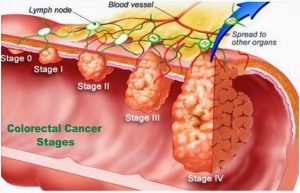
Phases of Colorectal Cancer Development
The Power of Early Detection
When colorectal cancer is detected at an early stage, the chances of successful treatment are very high. The earlier it is detected, the better the chances of successful therapy. Thanks to modern medicine, many patients are diagnosed and treated in time. Advances in surgical techniques, new chemotherapy drugs, and radiation therapy enable effective treatment and a good quality of life after colorectal cancer treatment.
Therefore, public awareness is extremely important. Regular preventive examinations are not just a medical recommendation—they are an investment in your own health and life.
Why Prevention Matters
Colorectal cancer often develops silently, but early detection can make a huge difference. With a combination of healthy habits and timely preventive examinations, it is possible not only to detect the disease early but in many cases to prevent it entirely. Sometimes, one timely examination can save a life.
Dr. Vladimir Mihajlovski
Specialist in Abdominal Surgery